Stores your clients own, on infrastructure you control
ShopNex is open-source commerce you run yourself. Admin, checkout, storefront and apps work out of the box, and one install can run many client shops. No platform plan, no per-site price changes, no one else’s roadmap.
Quick install
Why developers and agencies switch
Stop building client businesses on someone else’s terms
Platform fees, surprise changes and lock-in land on you and on your client. Running the store yourself takes them off the table.
No monthly toll for the basics
Plan, apps and transaction fees add up until a small shop pays hundreds a month.
✓ Catalog, checkout, orders, customers, staff and discounts are in the core. No platform plan and no cut of sales: you pay your host and your payment processor.
Changes happen when you decide
Forced redesigns, price changes and policy changes arrive on the platform’s schedule.
✓ You run it, so you pin the version and upgrade when you’re ready. The code is public and MIT-licensed, so nobody can reprice it.
Features without touching the core
A theme and three apps conflict, and nobody takes responsibility.
✓ Apps run outside the core and talk to the store through scoped API tokens and signed webhooks. No third-party code is loaded into it.
The data stays yours
Leaving a platform means rebuilding the store and losing history.
✓ Everything lives in your own PostgreSQL database, on your server. You can read and export it with standard tools.
For agencies and freelancers
One install, every client’s store
You keep the infrastructure, the update schedule and the client relationship.
Many shops, one install
Set TENANCY_MODE=multi and each client’s shop resolves from its own domain, with its own members. Switching from one shop to many needs no data migration.
Headless when you want it
Use the bundled Astro storefront with Liquid themes, or build your own on the typed Storefront API and SDK. Customers pay on the hosted checkout either way.
Integrations per client
Scoped API tokens and signed webhooks let you connect each client’s tools with exactly the access they need, and revoke it in one click.
No per-site pricing
MIT-licensed software, with no plan and no per-shop fee from ShopNex. Your costs are the server and payment processing.
Read the multi-shop guide or the Storefront API overview .
Everything built in
A complete commerce backend, not a starter kit
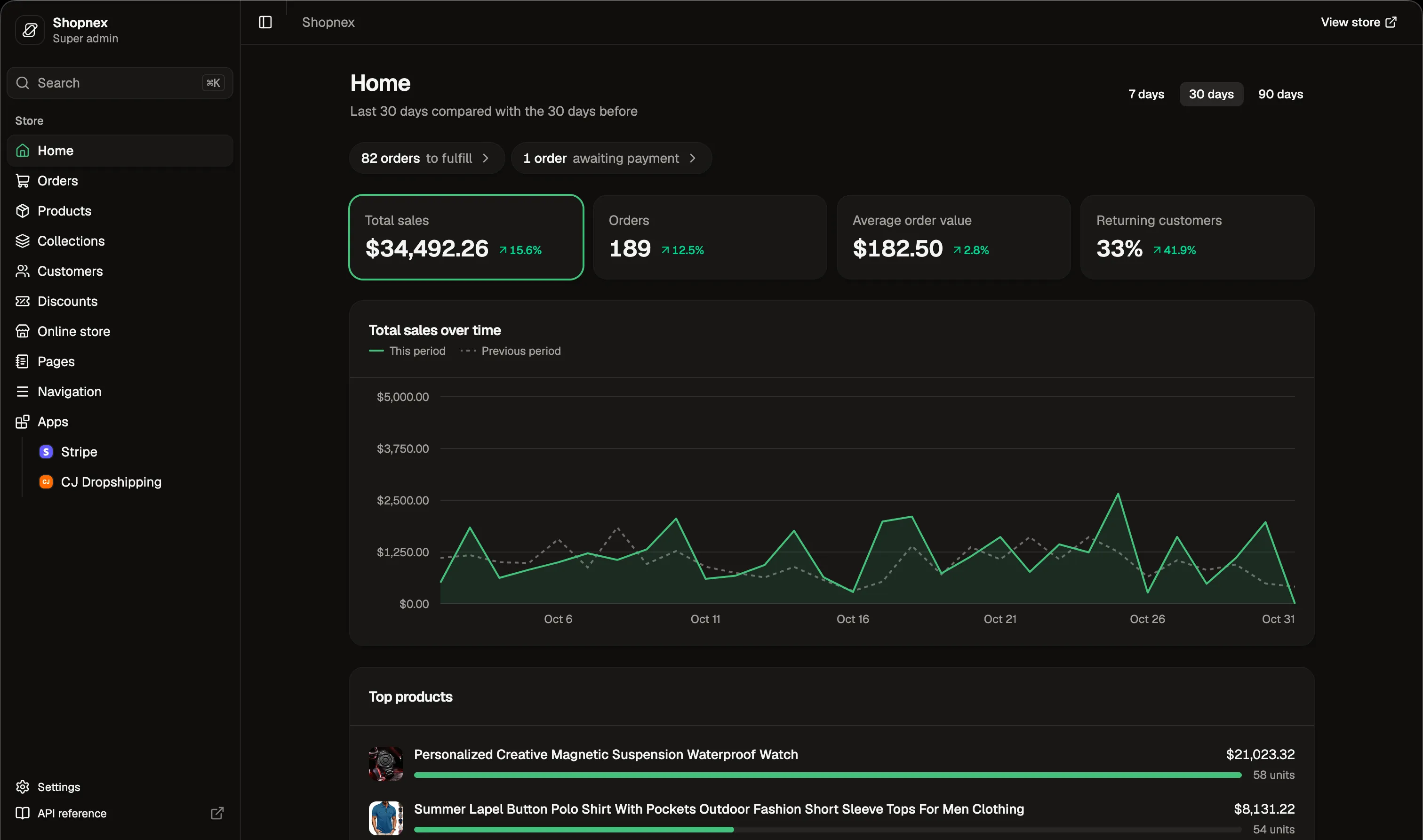
Products, checkout, orders, customers and staff are all included. Install it, finish the setup wizard and start selling.
Catalog
Products with options, variants, SKUs and stock per variant, collections, images and clean URLs.
Hosted checkout
One checkout every storefront redirects to: shipping rates, manual payment methods and Stripe Checkout.
Orders
Payment and fulfillment status tracked separately, shipping lines, transactions and price snapshots.
Customers
Accounts and guest orders matched by email, so every purchase lands on the right person.
Staff
Invite-only team with owner, admin and staff roles. No open sign-up page on your admin.
One shop or many
Run a single store, or switch to multi-shop by domain later without migrating any data.
For developers
Headless when you want it
Use the bundled Astro storefront, or build your own on a typed Storefront API modeled on Shopify's. An OpenAPI spec covers the Admin and Storefront APIs.
-
Typed Storefront SDK
Contract-first client with typed errors like
OUT_OF_STOCK, safe to use in the browser with a publishable key. -
Familiar model
Products, variants, carts and orders map closely to Shopify's Storefront API, so existing storefronts port over easily.
-
REST and OpenAPI
Every procedure is also served as REST under
/api/v1, described in a live OpenAPI document.
import { createStorefrontClient } from '@shopnex/storefront-sdk'

const shopnex = createStorefrontClient({
  baseUrl: 'https://your-shop.com',
  publishableKey: 'pk_…',
})

const { nodes } = await shopnex.products.list({ first: 20, sortKey: 'PRICE' })

const cart = await shopnex.cart.create({
  lines: [{ merchandiseId: nodes[0].variants[0].id, quantity: 1 }],
})
location.href = cart.checkoutUrl // hosted checkout
Extend it
Apps run beside your store, not inside it
Integrations talk to ShopNex over webhooks and scoped APIs. No third-party code is ever loaded into your core, so an app can't slow down or break your shop.
Webhooks
Order, product and customer events, signed per Standard Webhooks, retried for up to a day and redeliverable from the admin.
Scoped API tokens
Give an integration read or write access to exactly the resources it needs, and revoke it in one click.
OAuth apps
Merchants approve the access an app requests on a consent screen. Uninstalling cleans up its tokens and webhooks.
App Marketplace
Vendors publish apps once and every connected ShopNex install can find and install them from the App Store.
FAQ
Questions developers and agencies ask before installing
Who is ShopNex not for?
If you would rather not handle hosting, updates and backups, or your clients depend on a large catalogue of third-party apps today, a hosted platform is the better fit. ShopNex is pre-1.0 and its app marketplace is much smaller than Shopify’s.
Can I move a client’s Shopify or WooCommerce store over?
Yes, with the CSV import in the admin. Products, customers, orders and discounts can be imported from Shopify and WooCommerce export files, and products and customers from Magento too. Product images come in from the image URLs in the export. Themes aren’t converted: ShopNex uses its own Liquid format, so a theme needs porting.
How do I run several client shops?
Set TENANCY_MODE=multi, add each shop’s domain under Settings → Domains and verify it with a DNS TXT record. Each shop has its own members. The tenancy guide has the details.
Is ShopNex free?
Yes. It is open source under the MIT license, with no platform subscription and no per-sale fee from the software. You pay for your server and for payment processing.
What happens to the data if we stop using it?
It is in your own PostgreSQL database, so you can export it with standard tools.
Which payment methods are supported?
Stripe Checkout through the bundled Stripe app, and manual payment methods. Other providers can be added as apps that use the payment-session contract.
Comparing? ShopNex vs Shopify ShopNex vs Medusa Running a single store?